← Reviens sur :
Toxic Relationships: Hello and Goodbye, How to Protect Yourself? 🧿✨
They don't shout, they don't attack you head-on. On the contrary: they smile, offer a lukewarm "well done," put a heart under your story… then leave you feeling drained without you knowing why. If, after seeing them, you feel heavier, more tense, if your confidence wavers for no clear reason, you're not "overthinking it": you're picking up on a silent negativity. They're the subtle jealous ones, the masters of the conditional compliment ("that's great… but"), of mysterious disappearance when everything is going your way, or of intrusive curiosity about your projects. You can also spot them by the tiny barbs disguised as humor, by the palpable energy in the room, by those doubts that creep in… even though everything was fine five minutes earlier. And if you want to know more, we've created the main page that explains the evil eye without folklore to better understand the issues.
1. Identifying toxic relationships 🛑
Whether they're friendly, familial, or professional, these dynamics aren't always good for you, even if they seem to be. Identifying them is the first step to regaining control. Observe what's happening in your body (sudden fatigue, shortness of breath), in your mind (rumination, self-sabotage), and in your results (repeated minor setbacks). Then set boundaries: fewer confidences, more limits, no endless explanations. You don't have to justify your light. Return to your familiar routines (breathing, centering, quick journaling) and anchor your message with a clear symbol: your Ayoun accessory , standing upright like a flag of sovereignty. It says without a word: here, my energy is paramount. Protection , clarity, boundaries set, and you move forward, light and aligned. 🧢

2. Energy Consumption ⚡
You know those people who arrive with a full battery… and leave you at 3% without even a “thanks for the electricity”? They're not friends, they're walking smart meters. You give them your money, you reassure them, you explain, you advise them, and they just keep pulling the cord, again and again. The result: you lag. They stream in 4K. The siphoning doesn't always look like a disaster. Sometimes it's a “quick 8-minute voice message,” a “can you proofread this quickly?”, a “I'll pop in for a second” that lasts 1 hour and 12 minutes. Sometimes it's more subtle: they want to know everything (amount, date, contact, behind-the-scenes details), but give you nothing in return. Others put you in their internal weather report (“I'm not doing well, save me”), then disappear as soon as you've fixed the leak. Your energy isn't a free gas station.
And yes, we open the door to this kind of siphoning ourselves. By talking about our projects too soon, by overexposing ourselves when things take off, by ignoring that little voice in our gut that says "no." Want to turn off the tap? Start by stopping the self-serving system. Less sharing by default, more filters by design. Before each share, ask yourself: is it useful, is it aligned with your values, is it secure? If the answer isn't a resounding "yes," keep it safe in the draft.
Here is a quick, simple and foolproof Ayoun protocol :
Energy budget: set yourself a daily limit for time/listening/“small tasks”. When it's used up, it's over. Like mobile data: after 20 GB, it slows down and that's not good for anyone.
Social firewall : moves the "nice vampires" into asynchronous mode. Text only, no unannounced calls, group replies, chosen times. You help... but you don't burn yourself out.
The 48-hour rule: on your sensitive projects, silence for two days after making progress. Let the energy stabilize before sharing it. New things are fragile; protect them like a flame in the wind. Key phrase that closes the door: “I’ll get back to you when I have some bandwidth.” Polite, clear, non-negotiable.
Body scan: after each interaction, note: +2, 0 or -2 in energy. Two consecutive negative scores = immediate break.
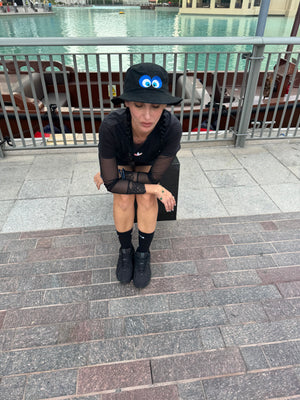
And the visual signal ? Your Ayoun cap , worn perfectly straight, is more than just a style statement : it's a "power under protection" sign. It reminds you (and others) that your attention is valuable, that your focus isn't free-for-all, and that you choose where the power flows. When you feel like too much is being drawn, activate " No Comment " mode: smile, posture, clear gaze… and not a single watt wasted on justifications.
Want to eradicate the mistakes that attract the evil eye—overexposure, misplaced confidences, sharing without grounding? Go read “ 5 Mistakes That Attract the Evil Eye Without Even Knowing It” and lock down your inner circuit. Then, get back to basics: you first, everything else later. Because a drained Ayoun is a no-go. A fortified Ayoun is a yes, and that's where the magic happens.
3. Impact on mental health 🧠💔
Living with people who minimize, nip at you, or sabotage you doesn't just damage your mood: it reprograms your brain into survival mode. Constantly bombarded with micro-digs and innuendo keeps your amygdala on high alert, cortisol levels constantly rise, and your mind shifts from creativity to protection. The result: you sleep poorly because you replay the scene in your head, you procrastinate because making decisions requires energy you no longer have, and you doubt yourself even when the facts prove otherwise. These aren't just whims: it's the cumulative effect of these micro-cuts on your self-esteem.
The signs are often subtle at first. You wake up tired despite eight hours in bed. You see your energy plummet after an "innocent" message. You simplify your thoughts "to avoid making waves." You avoid sharing good news for fear of the reaction. You get irritated easily, then you blame yourself. Your mind falters… and it makes sense: it's carrying too much invisible burden.
So what do we do? First, we name what's happening. Putting words to disguised jealousy reduces its power by 50%. Then, we shift the focus: less justification, more calm boundaries; less default presence, more conscious presence. Neurologically, your goal is simple: give back to the cortex (clarity, strategy) what the amygdala has hijacked (constant alertness). In practice, this looks like micro-rituals that help you refocus: 4-7-8 breathing after a difficult interaction, a 10-minute walk to release tension, a cold shower on your wrists to lower your blood pressure, three self-supportive phrases before reopening your messages. This isn't a luxury: it's mental hygiene.
And what about the visual anchor? Your Ayoun cap isn't just a gimmick: it's a Pavlovian anchor that you condition to your state of sovereignty. Every time you adjust it, your brain receives the instruction " safe & focus ." The design speaks for you, your posture follows, your inner voice rises a notch. You don't shout your truth, you radiate your boundary. This simple gesture breaks the loops of rumination ("I should have answered…") and helps you return to your body, where confidence breathes and clarity shines.
If you sense someone is envious of you, don't go looking for a formal complaint. Observe the pattern: your energy drops after seeing them, your speech becomes less forthcoming in their presence, and your projects stall when you share them too soon. That's enough to warrant action. Reduce access, cut down on airtime, change your communication channel (asynchronous communication > live calls), and nurture what's emerging until it's sustainable. And remember: peace isn't "earned," it's cultivated.
In short: your ideas need oxygen, not negative energy. Your mind wasn't designed to absorb everyone's opinion all the time. Give yourself spaces free from interference, retrain your inner voice, and choose symbols that support you. Ayoun isn't just an accessory; it's a silent rule of the game: my energy is precious, my mind is a sanctuary, I owe myself respect.
4. Positive energy vs. negative energy 🌞🌑
Think vibration, not just “mood.” We are all antennas: we receive, we emit, we resonate. Positive energy isn't a forced smile; it's an internal coherence (thoughts, emotions, posture) that flows smoothly. Negative energy, on the other hand, manifests as dissonance: words that contradict actions, stinging glances, lingering tension. When these two worlds collide, social dynamics take over: coherence attracts, dissonance repels.
Why do the most vibrant personalities seem to be targeted more often? Because they act as beacons. A beacon illuminates the sea… and makes the waves visible. Creative, sensitive, ambitious, and open-minded individuals—those who dare—possess a higher level of sensory awareness. They take in more information, therefore more beauty… but also more noise. This isn't a weakness; it's a superpower to be harnessed.
The key isn't to dim the lights, it's to filter the signal. Three concrete ways to do this:
Choosing your input—what you watch, read, listen to, who you have lunch with—all calibrates your frequency. Go on a diet of information that compresses you and overdose on what oxygenates you (movement, nature, creation, projects that expand your horizons).
Boundary hygiene: protect the times when your energy is at its lowest (morning, before a presentation, after a victory). No lengthy explanations: a calmly set boundary is a high frequency.
Visible anchoring : a gesture, an object, a code. Adjusting your Ayoun cap is like activating a shielded mode. Your nervous system understands, “Stand up straight, move forward.” And the world receives the message: no interference.
You don't have to "manage others." You have to manage your field: decide where you place your attention, who you let in, and at what volume you speak. Wearing Ayoun means consciously choosing the high-frequency channel: less interference, more reach. You don't fight negative energy; you rise above it. You don't apologize for shining; you simply adjust your intensity… and you continue on your path.
5. Strategies to protect your energy 🛡️
Going into shielded mode isn't a mood, it's a habit. And the good news is, it's something you can learn. The idea isn't to live in a bunker, but to set up smart routines that filter out noise and keep your light nice and warm.
Start by making your "no" a sanctuary. No doesn't need a lengthy explanation: "It's not for me," "I'm not available for that," "Thanks, I'll pass." Say it calmly, with direct eye contact and steady breathing. Every time you set a clear boundary, you're sending a message to your nervous system: I choose myself. Your self-respect begins right there.
Then, assert your needs without apologizing for existing. Do you need silence before a meeting, time to respond, or space to create? Say so. Your clarity protects better than any speech. The more specific you are, the more those around you will align (and those who refuse to adapt disqualify themselves).
Practice graceful distance from people who drain you for no reason. No drama, no scenes: less frequency, less intimacy, less availability. Three sliders to adjust without guilt. You'll see how your energy returns when you gently turn off the leaky taps.
Conduct a 3x3 energy audit each week: three people, three places, three types of content (social media, TV shows, news) that nourish you; three that drain you. Increase the former, reduce the latter. Simple, precise, and powerful. Your attention is your most precious commodity: invest it intentionally.
Reconnect with yourself through short, powerful rituals. Ten deep, controlled breaths (inhale through your nose, exhale slowly through your mouth), two minutes of silence with your eyes open, a few slow movements to loosen your ribcage and shoulders. The body understands before the mind; when it relaxes, the mind follows. Add a release journal: three lines to let go of what weighs you down, three lines to anchor what uplifts you. It's a quick reset that works wonders.
Practice uncompromising digital hygiene: mute, unfollow, and wait 24 hours before posting your latest successes. A fledgling project needs warmth and quiet, not a draft. You're not hiding anything: you're incubating. And you're sharing at the right time, from a solid foundation. Establish energy contracts before risky situations (tense meetings, busy dinners, public events): an intention ("I'll stay calm and clear"), a duration ("I'm here for 90 minutes"), and a polite exit phrase already prepared ("I'll leave you now, I have a commitment"). You enter aligned, you leave whole.
Develop an exit ritual after difficult interactions: mindful handwashing, a warm shower for a reset, a few seconds of walking in the fresh air, a glass of water, and a deep breath. These are like mini-portals: closing the old, opening the new. And above all, wear Ayoun. Visual anchoring is your neural shortcut. With every reflection in a shop window, every time you pass a mirror, your cap sends back your own message: My inner peace is sacred. I am protected . I am ready to move forward. It's not "just" an accessory; it's a state switch. Head held high, shoulders relaxed, gaze calm: your posture becomes your first prayer, your style your first boundary.
Finally, surround yourself with supportive people: those three individuals with whom you can celebrate freely, doubt without shame, and create without holding back. Nurture this circle, schedule it in your calendar, and ritualize joy. The more you cultivate what uplifts you, the less room there is for what drains you.
In short, protecting your energy is incredibly concrete: clear boundaries, chosen distances, regular resets, a deliberate focus… and a visible symbol that reminds you of your sovereignty. With Ayoun , you no longer wait for the world to become gentle: you become your own climate.
6. Liberation and letting go 🕊️
Cutting ties isn't betrayal. It's recognizing that your peace is worth more than a photo album on repeat. You can honor what has been and, in the same breath, close the creaking door. Loyalty to yourself isn't selfishness: it's an advanced form of honesty. You're not abandoning anyone; you're reclaiming yourself. And yes, the heart sometimes protests; it loves habits, even the painful ones, but it always ends up thanking the mind for making the decision the soul has longed for.
So make this separation a clean, clear, dignified act. No drawn-out legal battles, no three-part finale. One clear sentence is enough: "I choose my serenity." Eliminate the backtracking that pulls you back, the threads of conversation that lead nowhere, the "habitual" meetings, the "let's keep in touch" that only lead to repetition. Breathe new life into your lungs: releasing a toxic bond expands your inner space. In this new space, energy flows, creativity returns, and momentum is rekindled.
Allow yourself a little grief without creating a drama in your mind. There's the emptiness of the first few days, the temptation to re-check everything, the memories that come flooding back: it's all normal. Treat them like waves: they rise, they fall. Between waves, re-establish familiar routines: a route you love, a rearranged table, a playlist that sets you right. Reclaim your time: the hour the other person took becomes a moment for you, and this simple shift changes the entire emotional landscape.
Also, take a discreet inventory of the invisible benefits: deeper sleep, fuller breathing, quicker decisions, calmer skin, clearer thinking. These are physical signs that your system is saying "thank you." And when a touch of nostalgia tries to paint the past in rosy hues, remember the daily cost: the fatigue, the nagging doubts, the "little" barbs that were anything but. There's a reason they call it "turning the page": you can't stay stuck in the same paragraph forever.
In these passages, Ayoun isn't "just" a logo under a visor; it's your guiding totem. Adjusting the cap is like signing a contract with yourself: posture upright, gaze clear, energy sealed. This gesture anchors you back to the present with every mirror you pass, every reflection in a shop window. It's your portable reminder that rebirth begins precisely where you stop negotiating your worth. A soft armor, not to cut you off from the world, but to traverse it without losing yourself. And if, at the turn of a memory, the temptation to return arises, touch the strap, breathe, lift your head: your course lies ahead.
Leaving here means returning to yourself. It means choosing the light, even if at first it only illuminates a small circle around your steps. Give yourself a few days, and you'll see: that circle expands. Good encounters enter it, good ideas flourish, and your projects regain momentum without the invisible brake of old attachments. You're not "cutting off" a story; you're finishing it cleanly to write a better one. And you're starting it with a clear sign, above your thoughts: Ayoun , poised like a tranquil banner. Your mind is safe , your energy is at home, your future has space. 🌿🧢