
← Reviens sur :
Why do you feel exhausted after certain interactions? 👀
Sometimes, a single glance is enough to leave you feeling drained. Not a word, not a gesture. Just a presence, a look, a surge of energy that leaves you feeling weak. These feelings, long considered mystical or subjective, are now finding concrete scientific explanations . Psychology of stress, emotional contagion, relationship dynamics, and hormonal activation… What we call the “evil eye” could well be a form of silent neurobiological overload . We created the parent page to understand the origin and real impact of the evil eye.
This article explores clinical and neurobiological research to understand why some people, without even speaking, drain us mentally, emotionally, and physically . And most importantly, how to protect ourselves from them.

The phenomenon of energy vampires
Dr. Judith Orloff, a psychiatrist at UCLA, describes energy vampires as individuals who unconsciously absorb the emotional energy of those around them. They may be charismatic or silent, but the feeling after interacting with them is often the same: fatigue, confusion, oppression .
These profiles are numerous and sometimes difficult to spot. Chronic victims who constantly complain, domineering narcissists who monopolize space, silent passive-aggressives, veiled hypercritics... They all share a capacity to unbalance our nervous system .
According to a 2023 IFOP study, 62% of respondents stated that they had already fled a relationship perceived as draining. Nearly half of them associated this type of relationship with an immediate loss of energy . These feelings are therefore not paranoia: they are widely shared .
The power of the gaze : an invisible but neurologically active weapon
Some presences don't speak. They look. And that look is enough to trigger a biological alarm signal in us. Dr. Tania Singer, a neuroscientist at the Max Planck Institute, has demonstrated that contemptuous or cold looks activate three major areas of the brain: the amygdala, responsible for detecting threats; the cingulate cortex, linked to emotional pain; and the insula, associated with disgust and rejection.
This simple exchange of glances is enough to disrupt our inner stability. A 2017 Harvard study showed that exposure to critical faces causes a 21% decrease in cognitive performance and a 27% increase in cortisol levels , the stress hormone. In other words, a look can hurt without touching .
Micro-expressions: those subtle signals that trigger an internal storm
Even the most subtle expressions—a furrowed brow, a tense silence, a shifty gaze—can be perceived by the brain as danger signals. They are hormonal micro-triggers . The body picks them up before the mind even understands them. This is the basis of emotional contagion.
Emotional contagion and mirror neurons: emotions are transmitted
Discovered in Parma by Rizzolatti, mirror neurons explain our ability to imitate and absorb the emotional state of others , often unintentionally. Being around a tense, anxious, or aggressive person puts our own nervous system under strain.
A 2020 study from the University of Michigan observed that subjects exposed to an anxious person showed, after 5 minutes, an increase in heart rate and a significant decrease in heart rate variability , a marker of physiological fatigue. The energy of others permeates and changes us .
The social nocebo effect: when fear of the other triggers real stress
The fear of being judged, scrutinized, or emotionally overwhelmed is sometimes enough to trigger an anticipatory biological response. This is known as the social nocebo effect. Even without direct interaction, the mere anticipation of discomfort triggers a surge in cortisol, an accelerated heart rate, and a reduction in our mental capacities. This phenomenon has been documented by the journal Psychological Science since 2019.
Hormonal fatigue and measurable bodily impacts
Being regularly exposed to toxic environments, heavy stares, or unbalanced interactions increases nervous fatigue and decreases hormonal regulation .
At UCLA, a study showed that employees exposed to chronically negative colleagues for a week saw their perceived fatigue levels rise by 31% and their motivation drop by 26% . Emotional burnout doesn't just come from work. It can also come from the way we're perceived .
As Dr. Christina Maslach says, "It's not the amount of work that's exhausting. It's the toxic emotional burden that isn't released."
How can we protect ourselves without becoming insensitive?
The first step is to reconnect with yourself . Breathe. Refocus. Use simple neurophysiological tools like heart coherence, which helps reduce the impact of stress by regulating heart rate variability. Adopting an upright posture, a steady gaze, and slow breathing are messages the body sends to the brain to restore balance .
Self-affirmation is also a powerful defense. Mentally repeating protective phrases creates an energetic distance. "I am calm. I am centered. What doesn't belong to me doesn't affect me."
The role of symbols in energy protection
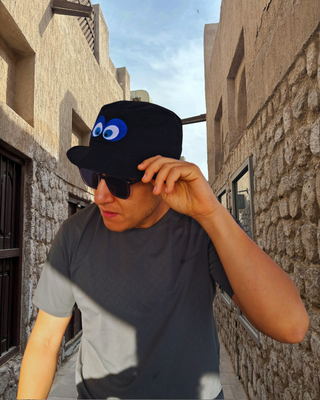
The brain loves visual cues. Wearing a protective object—an eye, a stone, a talisman, a cap—creates a powerful symbolic anchor; it's a way of saying to yourself and the world: I am protected, I am aware .
It's not magic, it's more like active mental programming , validated by neuroscience. What we often look at, what we wear, what we touch... enters our bodily awareness. And changes our inner posture .
Ayoun case : a modern bulwark against wearying glances
Ayoun caps are designed for this purpose. The embroidered eye acts as a symbolic mirror . It reflects intention. It creates a visual shield. The discreet, impactful messages, like “No Comment,” are coded signals. They say what we don't always dare to say out loud: I'm protecting myself. I won't let myself be affected.
Wearing Ayoun means allowing yourself to remain in your light, without letting yourself be drained. It means transforming an accessory into an energetic compass , a daily reminder of your own vibration.
Conclusion: The evil eye has a biology
What we call the "evil eye" is neither a spell nor a legend. It's a subtle combination of emotional contagion, micro-signals, hormonal activations, and internal imbalances. Certain presences tire us, certain looks exhaust us, because our nervous system reacts to them as if they were an invisible threat .
But there are simple, concrete, powerful ways to regain control over our energy . Breathing, intention, posture, symbols. And above all, awareness. Self-awareness. Awareness of one's space. Awareness of one's energy.
This is Ayoun 's entire commitment: to offer everyone a real, visible, stylish tool to remind themselves that our energy is precious . And that it deserves to be protected.

