← Reviens sur :
Want to know how to break free, align yourself… and vibrate at a high vibration? Consider writing 🧘♀️🧢
Give yourself a date. Not the kind of date you keep putting off until "when I have time," but a real, suspended moment where you put down your phone, breathe, and finally let your thoughts settle. Journaling, or introspective writing, if you want to sound fancy, isn't just another self-help gimmick. It's a gentle, non-judgmental therapy, a mirror that reflects without distortion, and a vibrational shield that puts your energy back at the center of the action… especially when it's accompanied by a clear intention. And if you want to know more, we've created the main page that explains the evil eye without folklore to better understand the issues.
With Ayoun , this ritual becomes a way of life. You open your notebook like you open a window: to let the air circulate, clear your mind, release trapped emotions, and let in more light. Writing soothes the inner noise, reorganizes priorities, and transforms "I don't know" into "this is what I choose." Better still, writing anchors your intentions in the physical world: each sentence you write down is a thought that stabilizes, a fear that loses its power, a decision that gains courage.
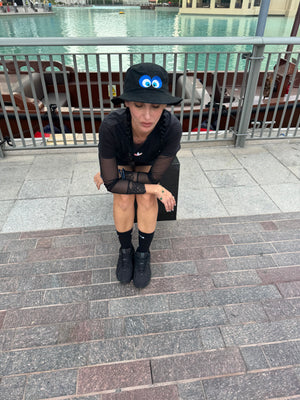
And because the head is the center of your thoughts (and the favorite target of negative energy ), we like to associate this moment with a visual anchor: an Ayoun cap placed on the table or on your head if you like to write outside, as a silent reminder that your space is sacred. You write, you align yourself, you seal yourself in: “Here, I protect myself, I refocus, I radiate.” A few minutes are enough to feel the difference: your mood softens, clarity returns, and your confidence rises a notch.
In practical terms, let your pen answer three simple questions: “What am I truly feeling today?”, “What am I choosing to let go of?”, “What energy am I choosing to cultivate going forward?”. No need for fancy words, much less a filter: honesty is enough. Day after day, these pages become your compass: they show you your cycles, your progress, your pitfalls, your victories. And above all, they remind you of this: your energy belongs to you. It's up to you to protect it, nurture it, and direct it with style, intention… and a touch of Ayoun . 🧿🧢

Create a space for reflection 🧘♀️🖋️
Imagine a notebook that never judges you, a blank page that listens to you better than any feed, and a date with yourself where you can finally let your guard down. That's what journaling is: a personal sanctuary where thoughts settle, emotions settle, and energy realigns. To amplify this "bubble" effect, start by setting a clear intention: "I protect myself, I refocus, I free myself," exactly in line with the natural defenses explained here, in a simple and concrete way. Then, create a scenario for the moment. Choose a place where your brain immediately understands that you're switching into introspection mode: soft lighting, a warm drink, your phone upside down, slow breathing. Open your notebook, write without filters, and, above all, establish a visual anchor. An Ayoun cap placed on your head or next to your pen is your energetic “do not disturb” that seals the space: your mind knows that the session is sacred, your body relaxes, and the parasitic waves stay at the door.
You'll see how everything aligns differently when intention meets ritual. A few lines to release the overload, a handful of sentences to clarify your direction, a deep breath to close… and there you are, lighter, clearer, more resilient. Here, you're not just writing words: you're rewriting your vibration with style , and under high protection . 🧿🧢
Clarifying your thoughts 🧠📄
Writing is like clearing your brain's cache. When your mind is buzzing, when ideas are jostling for attention like after a concert, picking up a pen and putting it all down on paper is like opening an overflowing drawer and finally putting everything in its place. You reclaim mental space, you find your train of thought again, and, by some kind of rational magic, you regain control of your day.
Start simple: one page to unload unfiltered, one page to sort by theme, one line for the day's intention. This mini-ritual transforms a confusing stream of thoughts into three clear decisions. You can even have fun highlighting what nourishes you and crossing out what drains you; over time, your brain learns to recognize what uplifts you. The result: less noise, more direction, zero self-sabotage disguised as "I'll deal with it later."
Add a visual and physical anchor to solidify your focus. Putting on an Ayoun cap before you write is like telling your mind: “concentration mode activated.” With your head covered and your gaze focused, you enter a creative tunnel where distractions stay at the door. You'll see, posture changes writing, and writing changes posture. And when the page closes, you carry that focus with you like a bubble of clarity that accompanies you throughout the rest of the day.
Remember: confusion attracts negative energy because it creates openings, while clarity acts like a beacon. The more you write, the clearer your vision becomes; the clearer your vision, the more luck "recognizes" you. A single anchor phrase can suffice: "Today, I choose precision, I protect my energy, I stay aligned." Say it, write it, wear it. And let your Ayoun cap serve as a silent reminder every time your gaze meets your reflection.
Identifying your emotions 💭📓
When everything is a jumble, it's not "too many emotions" that overwhelm you, it's mostly nameless emotions. Journaling is precisely what helps to put clear labels on this great inner mess. As soon as you name what you're feeling—sadness, anger, shame, fear, jealousy, pride, gratitude—the intensity drops a notch. "Name it to tame it," as neuroscientists say… and as people who have cried in front of their fridge at 11 p.m. say.
Start simple, without striving for perfect prose. Write: “Right now, I feel…,” then let three words come to you, even if they're clumsy. Next, locate them in your body: “Where does it feel tight? Where does it feel hot? Where does it feel empty?” You already have a powerful duo: label + sensation. Add a third element: the trigger. What lit the fuse? A message seen too late, a lingering glance, a toxic comparison, an unspoken expectation? In three sentences, you go from “I feel bad” to “I'm angry, there's a tightness in my chest, because I interpreted that silence as contempt.” It's precise, therefore manageable.
If the emotion is stalling, translate it into a need: “What do I really need right now?” Clarity? A “no”? A hug? Fresh air? This little exercise transforms rumination into action. You can even reply to your journal in the present tense, as you would to a friend: “I understand. Let’s set a boundary, have a glass of water, and then send this clear and concise message.” Yes, you can be your own coach (without judging yourself).
A quick ritual when things get overwhelming: two minutes of breathing, three lines to name your needs, one line for what you need, and one tiny decision to make within the hour. And if you need a physical anchor to stay centered, put on your Ayoun cap before you write. This gesture transforms the notebook into a protected space: head covered, gaze focused, you are in your emotional dojo. The cap becomes a discreet reminder that vulnerability isn't a weakness, but a strength you're learning to harness.
A little bonus of joyful clarity: not all emotions need to be "fixed." Some simply need to be seen, written down, and then let go. Note the time, the context, the intensity out of 10, and promise yourself to reassess in 24 hours. In many cases, the wave subsides on its own, and you remain in control, aligned, centered, ready to resume your day without being swallowed up by negative energy.
Express your creativity 🎨🖊️
Journaling isn't an Excel spreadsheet; it's a portable art studio. Forget the "perfect" page and neatly arranged sentences: here, you scribble, you cross out, you paste, you play. Your page becomes a testing ground where you paint with words, you dance with ideas, you sing with colors. One day, it's a quirky poem that makes you smile. The next, it's a three-panel mini-comic, a collage torn from a magazine, a mantra-like phrase written in bold with a marker that really pops: "Today, I choose my vibe." Transform your emotions into raw material. A spike in stress? Scribble zigzags until the lines soften. Overflowing with joy? Write quickly, big, diagonally, then add a shower of little stars. A craving for something new? Glue together fragments of textures (a metro ticket, a scrap of fabric, an old photo) and create your “shedding page”—the old skin disappears, the new one arrives. The page of your journal becomes an energizing mirror rather than a judge: it reflects what you are going through and sends back to you a recharged version of yourself.
Have fun with different formats. Describe your day like a movie scene, using dialogue. Compose a weather haiku about your morning mood. Write a letter from your future self explaining how you achieved your goal. Let your fear speak for two minutes… then respond to your courage. Draw a mind map of your ideas going in all directions, then circle the one that ignites your passion the most: that's your next micro-step.
Play with your senses. Assign a color to your day and highlight three keywords of the same hue. Create a “soundtrack” for your entry (a song, a rhythm, even just a drum written in pen). Add a scent—a drop of essential oil on the corner of the page—to anchor the moment in your body. And when you adjust your Ayoun cap before writing, you symbolically turn on the light in your inner studio: it’s the click that says “time to create.”
Set yourself some fun little constraints: a ten-minute time limit, a pen that can't stop writing, an entire page without using the letter "e," a "parade of bad ideas" where you deliberately list absurd suggestions... until you stumble upon the right one. Constraints unleash inspiration like a dam creating a current.
Finally, reread without self-sabotaging. Look for the spark, not perfection. Circle what inspires you, copy it in large print on the next page, and transform it into a micro-action for tomorrow. Make each session a small celebration: a flourish, a "YES" in marker, a smile that says "creative, aligned, protected." Your creativity doesn't need permission, just an appointment.
Set intentions and goals 🎯📔
Writing down your goals is much more than simply "jotting them down for later." It's about calling them by name, giving them an address, a move-in date in your reality. When you put your intentions in black and white, you stop "wanting" and you start orchestrating. Each sentence becomes a frequency. And frequencies attract evidence.
Start with your intention—simple, clear, and stated in the present tense: “I cultivate calm and powerful energy every day.” Add observable evidence: “This is evident because I get up 10 minutes earlier to breathe, and I say a real no when necessary.” Finish with your micro-action for the day: “Today, I turn off my phone at 10 p.m. and write three lines of gratitude.” In three steps, you have an intention (the goal), evidence (the reality), and an action (the step). This trio replaces procrastination with movement. Let your goals breathe. Too many to-dos kill momentum. Give them a living form: a verb, a setting, an emotion. “I launch my creative project with lightness and precision.” Visualize yourself doing it, feel the room, hear the focused silence, then write what you will do in the next 24 hours so that this movie truly begins. Intention aligns, image anchors, action seals.
A little tip from an inner athlete: shift from a "results" goal to an "identity" goal. Instead of writing "Earn X," write "Become the person who organizes themselves, creates value , and gets paid what they're worth." Your brain loves this shortcut: when your identity changes, your habits follow. And if a doubt creeps in, respond to it on the page like an unwanted guest: "Thanks, but today we're moving forward."
Make your intentions audible . Read them aloud, calmly, like reciting a promise that matters. The body registers what the mouth affirms. It's even more powerful if you create a mini-ritual: adjust your Ayoun cap , place your hand on your notebook, exhale once, and pronounce the key phrase of the day. This gesture becomes a visual and tactile anchor: with every reflection in a window, every slump, your mind remembers the pact. Think "scenes," not "mountains." Write down the scene for tomorrow morning, tomorrow at noon, tomorrow evening. "Tomorrow morning, I send this email. At noon, I walk for 15 minutes to clarify my thoughts. In the evening, I summarize in three lines." Three scenes are enough to avoid chaos and achieve realistic victories. And if a day goes off the rails, don't throw away the film: rewrite the next scene. You are the director.
Measure without beating yourself up. One line is enough: “What has progressed,” “What I’m learning,” “What I’m lightening my load.” No need for a detailed accounting. Seek progress rather than perfection. Intentions don’t like pressure; they thrive on consistency. One degree a day, and the trajectory changes course. Finally, give your month a title, like an album: “February: Solar Concentration,” “March: Effective Gentleness.” Every morning, rewrite the month’s guiding intention at the top of the page. Every evening, check off one piece of evidence, however small. Accumulation creates evidence, and evidence creates confidence. And confidence… that’s precisely the stuff of the strongest defenses.
In short: a clear intention, visible proof, one small action today. A simple ritual, an Ayoun cap as your totem, and your journal becomes a vibrational dashboard . You no longer chase your goals: you make them inevitable.
Practicing gratitude 🌟🙏
Gratitude isn't a polite "thank you" tossed between emails. It's an energetic exercise. Three sentences a day are enough to train your brain to recognize what's going well, and—spoiler alert—what's going well ends up multiplying. Start small, but start specific. Instead of "I'm grateful for life," write "the coffee was exactly the right temperature," "the cashier smiled at me like we knew each other," "I stuck to my limit without feeling guilty." The more concrete it is, the more it sticks.
The right moment is the one you have. In the morning, gratitude acts like a mental vitamin: you start your day in "opportunity-receiving" mode. In the evening, it acts like a dust filter: you remove the sand from your shoes and keep only the gold. If you only have a minute, write it in the present tense, with a pen, breathing slowly, then read your three sentences aloud. Your nervous system loves this combination: writing, breathing, listening.
Your Ayoun cap can become the switch for this ritual. You adjust it, open your notebook, and your body understands: it's the "thank you" moment. This gesture transforms gratitude into a visual anchor, a kind of energetic bookmark. You train yourself to look for evidence that life is conspiring for you, even on average days, especially on average days. And if inspiration is lacking, ask yourself three questions that unlock everything: "What made me feel lighter today? What made me laugh? Who deserves a silent thank you from me?" Write down the first answer that comes to mind, without editing, without embellishment. Elegance will come with the momentum.
Sometimes add a sensory touch. Describe the texture of a moment, the color of a sky, the scent of a memory. The more you engage your senses, the more you "code" gratitude into your body. You can even draw a small recurring symbol—a star, an eye, a lightning bolt—next to the passages that resonate with you. As you turn the pages, you'll see your map of luck take shape. And that's where the magic happens: you no longer wait for grand miracles, you collect micro-miracles, and you become, quite literally, magnetic.
Track your personal progress 🚀📖
A journal is a record of your progress. You might think you're stagnating… until one day you stumble upon a page from three months ago and read it like you would an old selfie: same person, different pose. This journal proves to you, in black and white, that you're moving forward, sometimes slowly, sometimes sprinting, but always in the right direction. Rereading isn't about self-judgment; it's about identifying useful patterns: what gives you momentum, what holds you back, what you can repeat without getting tired.
Set elegant milestones. Every weekend, record a three-line “progress snapshot”: what you learned, what you’re leaving behind, what you’re choosing for the future. At the end of each month, write a short letter from you to yourself: “This is where I am, this is what surprised me, this is what I stand for.” This transforms your pages into a timeline of power, not a repository of jumbled thoughts. And if you like tangible markers, draw a small confidence thermometer, an energy barometer, a serenity gauge. Nothing scientific, just something to visualize the evolution. The brain loves visual evidence; it works best when it sees its progress.
Also, observe your “trigger moments.” Under what circumstances does your energy rise quickly? What details do you get carried away by? Put it into words. Once you've identified two or three recurring patterns, you can adjust your daily trajectory: more of what nourishes you, less of what drains you. And when doubt creeps back in (it will come again, it's polite), open the “evidence” section of your journal: recorded victories, set boundaries, followed intuitions, risks taken. Reviewing your own evidence resets you to your original frequency.
Your Ayoun cap acts as a milestone totem. Wear it during your monthly reviews to ritualize the appointment: you enter "honest assessment + clear direction" mode. It's subtle, but powerful. You condition your body and mind to associate the journey review with a feeling of stability and momentum. You can even dedicate a special " Ayoun direction " page at the end of each month with three guiding principles: what I protect, what I amplify, what I simplify. Intention becomes direction, direction becomes habit, habit becomes identity.
And don't forget to celebrate. Not just the visible trophies, the signatures, the numbers, the likes, but the invisible victories: the time you said no without trembling, the conversation where you spoke up without minimizing yourself, the night you chose yourself. Write them down. Underline them. Have a little celebration in the margins. It's by celebrating the journey that you create the desire to keep going. Your pages then become clean fuel: they don't weigh you down, they propel you.
Gratitude that strengthens, follow-through that proves, a symbol that anchors—this is the trilogy that changes everything. Write to see, reread to believe, wear to embody. And continue on your path, creative, aligned, protected.
Take a step back 🔍🖋️
There are days when your brain feels like Chrome in a panic: fifteen tabs open, three playlists overlapping, and you in the middle, searching for the pause button. Writing is precisely that button. You go from a 100x zoom to a wide shot, from the actor tossed about by the scene to the director regaining control of the frame. You're not looking for the pretty phrase, you're looking for the right one. You're not creating literature, you're creating clarity.
Sit down, breathe, and shift into a broader perspective. Lay out the words like you're arranging footage on a timeline: what happened, how it made you feel, what you want to do with it. Three questions are all it takes to get things back in the right place: what belongs to me, what belongs to others, and what do I choose to keep to move forward? No need to write for a long time, just write truthfully. As soon as the truth lands on the page, the ruminations fade away, like background music being turned down a notch.
And to seal this moment, adjust your Ayoun cap like you're activating a firewall. Short gesture, long effect. Your brain understands that you're entering a protected zone: distractions on airplane mode, priorities in high definition. In a few lines, you regain your focus, you rediscover that efficient calm that makes you magnetic, and you're back in control of your film. Action! We're rolling this time with you at the controls.
Incorporate wellness rituals 🌺🧘♀️
Clarity doesn't happen by magic; it's cultivated. Create a simple sequence: breathe, settle, write, and repeat it until your nervous system recognizes it as an invitation to peace. Three minutes of deep inhalation, one minute of even slower exhalation, then pen on paper. If you want to intensify the feeling of being in a bubble, take off your cap: it's your crown of silence, your "turn off the noise" signal.
Over time, this micro-ritual becomes your buffer zone between the outside and the inside. You leave behind the dust of comparisons, you emerge lighter, more centered, ready to move forward… without being swept away by the emotional weather of others.
Set up this appointment with yourself like you would a discreet alarm: same place, same time, same anchoring gesture. A chair by a window, your favorite notebook, a hot cup of coffee, your cap adjusted… Your body will eventually understand that this is where you disconnect from the noise. Start with just three lines if the blank page intimidates you: “Today, I feel…”, “What weighs me down…”, “What I choose to keep…”. You don't write to be published, you write to set yourself free.
When your mind races, change the pace. Take a "physiological sigh": a deep breath in through your nose, a shallow breath in again, a long exhale through your mouth, then pick up your sentence where you left off. If a persistent thought knocks at the door, write it down once, put a box around it, and promise to revisit it later. You transform obsession into information, information into a decision. That's when clarity arrives.
Create an exit ritual too, as important as the entry. Reread your last paragraph, underline a key sentence, and copy it in large print—this is your breadcrumb for the next session. Close your notebook, take off your cap for a few seconds, like raising a curtain after a rehearsal, then put it back on if you want to keep this active silence with you for the rest of the day. You're not leaving the bubble: you're taking it with you.
Vary the intensity depending on the time of day. In the morning, write short, focused notes to structure your day. At midday, take five minutes to unwind and wash away the microaggressions. In the evening, let go of everything that isn't yours, give thanks for what has sustained you, and leave the rest outside. Each time, use the same visual anchor: your cap is on = a boundary is established. Your head becomes a clear space. Your space, a protected zone. And your direction, a clean, elegant, unwavering line.
Reconnecting with your body 🤸♂️🖊️
Your body is a dashboard sharper than an airplane cockpit. It beeps before your head, it flashes before your thoughts: tiny prickles at the nape of your neck when a boundary has been crossed, a tight stomach in an overheated room, shortened breaths after a bad joke. Shake hands with this radar instead of silencing it. Open your notebook and transform journaling into a somatic scanner: “Where does it pull? What's the texture? Hot, cold, heavy, electric? What needs attention right now?” Write down the answers without correcting, without judging, like noting vital signs: “knot under the collarbones,” “fog behind the eyes,” “tightness on the right side.” You're not writing poetry, you're taking measurements.
From that point on, everything changes. Fatigue is no longer inevitable, it's a warning. The warning becomes a given, the given becomes a choice. You drink a large glass of water, you go look at the sky for five minutes, you unroll your spine vertebra by vertebra, you say a clear and firm "No, thank you." Sometimes the right response is a piece of fruit, sometimes it's silence, sometimes it's a step outside. The important thing is the connection: sensation → word → micro-action. Three pearls on the same thread.
Add a visual anchor to solidify the protocol: the Ayoun cap , firmly in place. It acts as a portable beacon, a discreet reminder that your boundaries are not up for negotiation. You feel it, you remember. It becomes your postural metronome: you relax your jaw, lower your shoulders, lengthen your exhalation. The simple weight on your head invites you to grow taller without tensing, to occupy the space without apologizing. You are not in defense mode, you are in sovereignty mode.
When a word stings, write it down exactly as it is, then observe the ripple through your body: “a prickling sensation under your breastbone,” “tingling in your hands.” Name it, tame it, choose. Perhaps the response is to step away for three minutes; perhaps it's to address the situation calmly; perhaps it's to laugh and move on. You go from reflex to response. And the more you practice, the shorter the delay becomes between the prick and the right action. That's true luxury: having time to react within yourself.
Create your own little one-minute protocol: two cycles of deep breathing, a guiding phrase you write at the top of the page (“My energy belongs to me”), a check of your neck, shoulders, and jaw, a micro-decision for right now. Close it. Move forward. The cap remains like a flag planted at the summit: you took the time to listen to yourself, so you can accelerate without losing yourself. And that's where the magnetism works: a body attuned + a clear mind = a presence that attracts effortlessly. You didn't shout anything, but everyone understood.
Conclusion ✨🧡
Journaling isn't a fad, it's a form of inner hygiene. Page after page, you untangle the unnecessary, you reclaim the essential, you transform noise into direction. Add gestures that reflect who you are—a slow breath, a sip of water, an Ayoun cap that signifies your intention—and your journal becomes more than just a notebook: a safe space, an accelerator of alignment, an amplifier of positive energy.
Write to see yourself, reread to believe yourself, embody to shine. And when the world is in turmoil? You know where to find yourself: in your words, beneath your "crown," with your energy intact and your course clear.
Ready to continue the journey, light, clear-headed, protected? Open your notebook. Adjust your cap. And move forward calmly, powerfully, irresistibly aligned. 🧿🧢